Guaranteed Execution on Solana: What Becomes Possible for Institutions and Protocols.
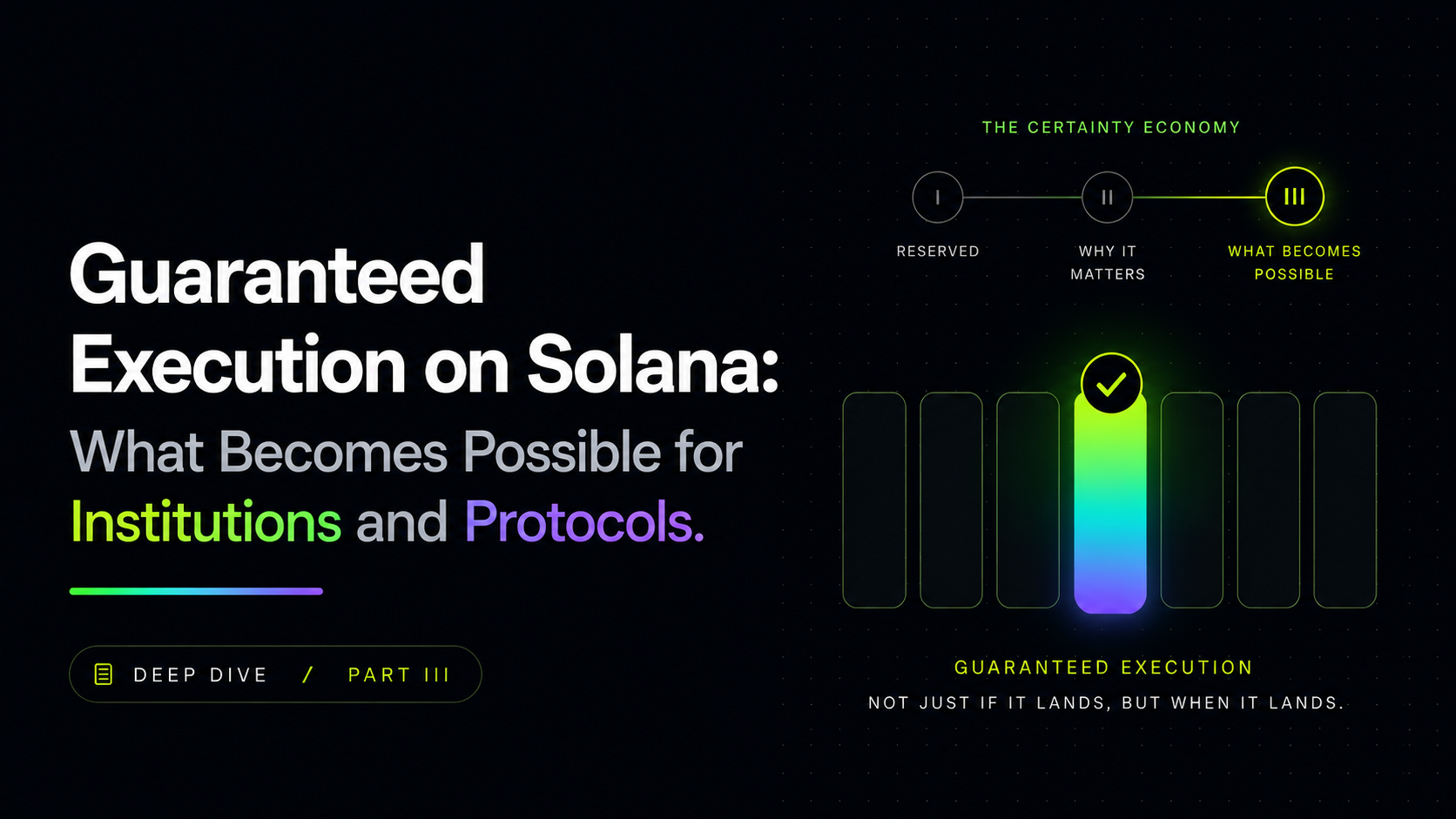
TL;DR: Solana guaranteed execution changes more than reliability. Once a transaction can be counted on to land at the moment it matters, protocols can loosen risk parameters they set against an unreliable network, institutions get the settlement certainty they need to move real money on-chain, and Solana can sell something it never could: a guarantee, not just a chance at the next block. This piece covers what that unlocks for the protocols already here, the institutions arriving now, and the network itself, and why institutional settlement on Solana depends on it.
The first two pieces in this series showed that public blockchains never guarantee your transaction lands when you need it, only that once it lands, it settles, and that the cost of that gap gets paid whether you notice it or not. Raiku's answer was to sell the guarantee directly: reserve blockspace ahead of time, or claim it the moment you need it, so a specific transaction lands at a specific moment.
That was the problem and the mechanism. This piece is about what it makes possible. Once a transaction can be counted on to land when it matters, protocols can build things they could not risk before, institutions can trust the chain with money they kept off it, and the network can offer something it never could. The rest follows that through three places: the protocols already here, the institutions arriving now, and Solana itself.
How execution certainty changes DeFi protocol economics
Start with the protocols already on Solana, because the change shows up in their numbers first. A protocol's risk parameters reflect two things: what can happen to a position, and how reliably the protocol can respond when it does.
A liquidation threshold, a maintenance margin, an insurance fund, a market-maker spread. Each is set around assumptions about how fast prices can move, how much liquidity will be there, and how quickly the protocol can act. Execution is that last assumption. If a liquidation can be delayed when the network is congested, the position needs more room before it goes underwater. If a stale quote cannot be pulled in time, the market maker builds that risk into every quote. The reliability of the response is already priced into the numbers, whether or not a transaction ever fails.
Execution certainty changes that one input. It does not slow volatility or create liquidity. It makes the protocol's ability to act predictable, and a parameter set against an unpredictable response has less reason to stay where it is. The rest depends on what the protocol was protecting..
1. Perpetuals
A perpetuals exchange competes on how tight its market is. The tighter the spread between buy and sell, the better the venue, and the spread is set by market makers, and a market maker's core fear is being picked off. It posts a quote, the price moves, and for a moment, that quote is stale. A faster trader hits it at the old price before the maker can cancel. The defense is being able to cancel in time, and when a maker cannot count on that, it quotes wider to cover the risk. Everyone on the venue pays that wider spread.
Hyperliquid showed what removing the uncertainty does. It built its order book so cancels are always processed ahead of incoming trades, so a maker can pull a stale quote before it can be hit. That is why makers there quote tighter and the book deepens under stress instead of thinning out. But Hyperliquid got there by building its own chain, and most applications never will.
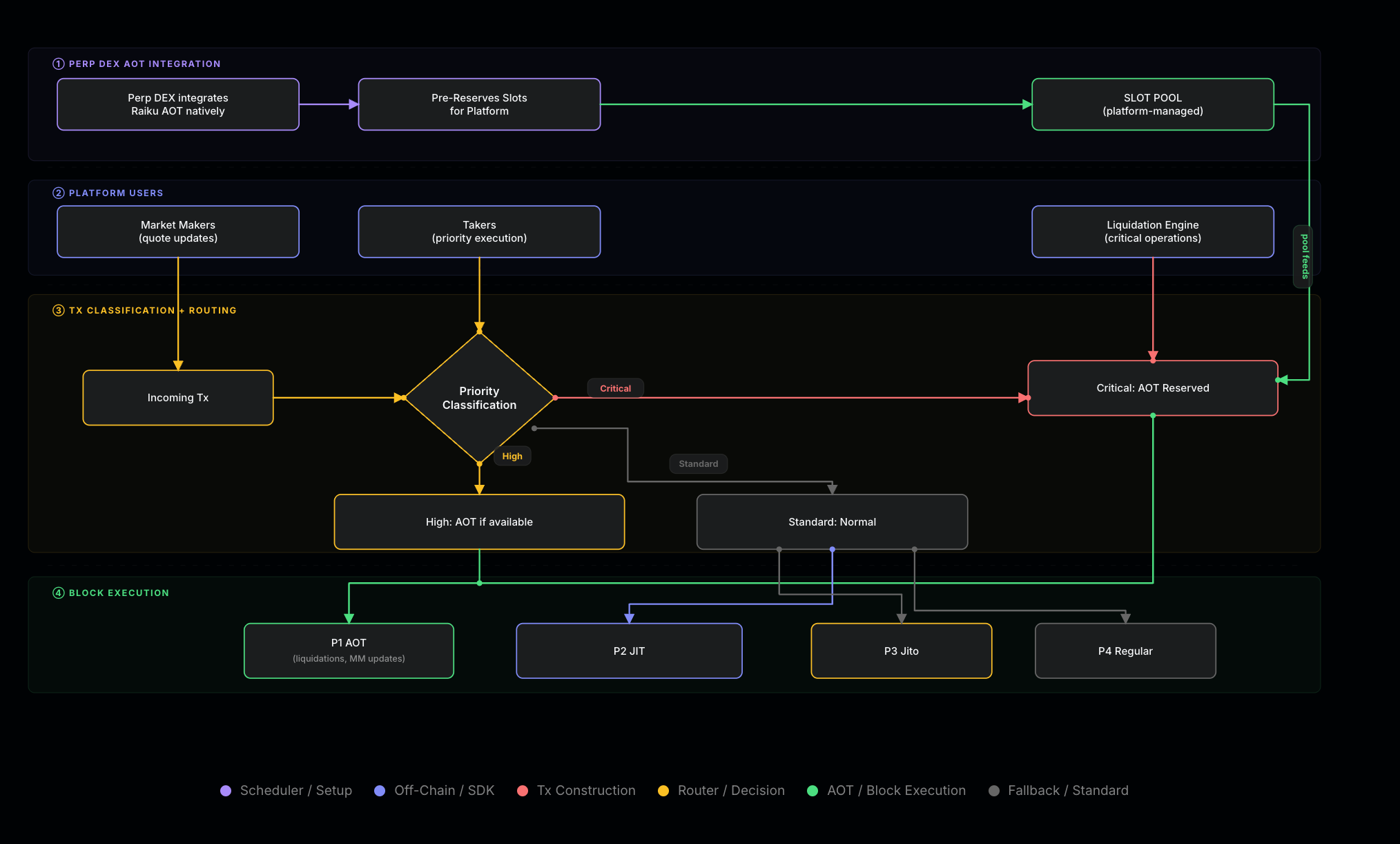
Raiku closes that gap on the shared chain by sorting transactions by urgency. A perps exchange pre-reserves a pool of slots, then classifies every transaction. Liquidations and margin calls are treated as critical and always land in a reserved slot. Market-maker quote updates get the next tier, a reserved slot when one is free and just-in-time execution at around forty milliseconds when it is not. Regular trades go through the normal way. When the block is built, the order is fixed: reserved liquidations and quote updates first, then just-in-time, then everything else.
For the maker, that is the protection Hyperliquid built into its own chain, delivered on the one every application shares. When a quote goes stale, the cancel gets priority instead of waiting behind unrelated traffic, so the maker is no longer exposed just because the network was busy at the wrong moment. The charge the maker was adding to every spread was never about the trade. It was about the chance the cancel would not land. Remove that chance and the spread can tighten, with no private chain required.
2. PropAMMs
A PropAMM is a market maker run by one firm: its own capital, its own pricing, no public app. Traders never reach it directly. Aggregators like Jupiter compare every market maker and route each trade to whoever has the best price at that instant. The freshest quote wins.
That makes execution the whole game. The firm sets its price off-chain, then has to post each update on-chain in time. If the update lands first, the firm wins the trade. If it lands late, the trade routes to a competitor, or a faster trader picks off the stale quote before it refreshes. Good pricing does not matter if the update is slow to land.
Raiku changes nothing about the pricing and everything about the delivery. It guarantees the update lands first, by reserving the firm a slot ahead of time and falling back to a fast on-demand slot when one is not held. The freshest price gets in ahead of the queue instead of fighting for space. For a PropAMM, that is the line between winning routes and getting picked off.

3. Settlement
The first cases are about doing what protocols already do, but on firmer ground: tighter spreads and quotes that land. Settlement is different. Here uncertainty does not raise the cost, it removes the option.
Some operations have to happen at an exact time. A tokenized fund redeeming at a set window. An oracle repricing on a fixed interval. A coupon paying on its due date. You cannot size a buffer around a deadline. A redemption that has to clear at four o'clock is not made safer by holding extra collateral. It either lands in its window or it fails, and a settlement process that might fail on timing is not one a serious operator runs on-chain at all.
So uncertainty here is not a wider parameter. It is a ceiling on what gets attempted. The operations that need guaranteed timing stay off-chain, or run in a stripped-down form with a manual backstop. Reserving a slot in advance for a redemption window or a scheduled update is the difference between a settlement process that can run on-chain and one that cannot. This is the narrowest change of the three and the largest in consequence, because it does not make an existing market more efficient. It makes a new one possible. Who needs that guarantee most is not the protocols already here. It is the institutions arriving now.
2. What changes for institutions
The protocols already on Solana can tune their parameters around execution risk and live with what is left. Institutions cannot. For the capital arriving now, guaranteed execution is not an efficiency gain but a precondition, the thing that has to exist before the money moves at all.
Why settlement needs execution guarantees that trading doesn't
When you trade, a failed transaction is an annoyance. You resend it, maybe at a worse price, and move on. The position is unchanged and nothing downstream depended on that exact attempt. Settlement works the other way. It is the moment ownership actually changes hands, and everything built on top of it, the books, the collateral, the next transaction in the chain, assumes it happened cleanly and on time.
That is why a failed settlement is not a retry, it is a break. A redemption that burns the token before the cash leg confirms leaves either phantom supply backed by nothing or capital trapped mid-transfer. A collateral movement that lands late can trigger a margin call that should never have fired. A coupon or a payment that misses its window breaks an obligation that other parties have already priced and planned around. In trading, timing costs you an edge. In settlement, timing costs you the integrity of the record.
Traditional finance spent decades removing that risk. Clearing houses, fixed settlement windows, delivery-versus-payment, custody, the whole apparatus exists so that when an institution commits, the transaction completes, at failure rates measured in fractions of a percent. That reliability is now so deep in the plumbing that an institution no more wonders whether a settlement will land than whether the lights will come on. It is assumed. And it is the assumption an institution carries onto any new venue, including a blockchain. A chain that cannot meet it is not a settlement venue, whatever else it can do.
Which institutions are settling on Solana
The capital moving onto Solana now is not chasing memecoins. It is the kind that settles.
Visa settles card obligations in stablecoins on-chain, moving real interbank money over the network rather than trading on it. Franklin Templeton runs a tokenized money-market fund with its share records kept on-chain, meaning the official book of ownership lives there. BlackRock's tokenized fund is being posted as collateral through regulated custodians while it keeps earning yield in the background, collateral that has to be movable on demand when a position needs it. Tokenized treasuries are being redeemed across borders and between banks outside normal banking hours, settlement that used to wait for a business day. And the DTCC, the clearing house that underpins settlement for US securities, is building its own tokenization platform with dozens of the largest institutions involved.
Read that list by what these firms are actually doing, not by their names. None of it is speculative trading. It is settlement, custody, and collateral, the operational core of how money moves. When an institution brings that on-chain, it does not lower its standards to match the venue. It brings the settlement standard with it and expects the venue to meet it.
What Solana's upgrades still can't guarantee for institutions
Solana has already fixed most of what used to keep this capital away. A second validator client removed the single point of failure that made outages a board-level risk. Fees fell and steadied. Finality keeps dropping toward the sub-second range. On paper, the network now clears the bar an institution sets for cost, speed, and uptime.
But every one of those improvements is an improvement to the average transaction, and the average is exactly what settlement cannot rely on. The transaction that matters to an institution is never the median one. It is the redemption that has to clear at its stated window, the collateral update that has to post before a margin call is evaluated, the payment that is due at a specific time and is a breach one minute late. For those, "faster and cheaper on average" is not an answer, because the failure that hurts is the rare one that happens at the worst possible moment, under exactly the load that makes the network least predictable.
That is the gap the upgrades do not close. Firedancer, lower fees, and faster finality make the network better on average without making any single transaction certain, and settlement is a business of single transactions that cannot miss. Reserving a specific moment in advance is the one guarantee the network has never offered, and it is the one an institution needs before it will run its book on-chain rather than merely park assets there. Until that exists, the pattern holds: institutions custody on Solana and settle somewhere else, and the largest flows stay in the systems that already promise what the chain cannot.
3. What changes for Solana
The first two sections were about users of the network. This one is about the network itself, because guaranteed execution changes what Solana is selling.
Solana today sells one product to everyone
Right now the network offers one product: a chance at the next block. You pay a priority fee to improve your odds, but paying more only makes inclusion more likely, not certain, because Solana does not order transactions deterministically by fee. Under load, a transaction can be delayed or dropped no matter what it paid. A memecoin snipe that can be retried a hundred times and a fund redemption that has to land at four o'clock face the same non-guarantee. The network has no way to treat the redemption differently, because it has no notion that one transaction matters more than another.
That works when the network is calm. Under load it fails exactly where it matters most, on the transactions that cannot be retried, because the network has no way to tell them apart from the ones that can.
Certainty lets the network sell different products to different needs
Raiku's routing already does this in miniature: a critical transaction gets a reserved slot, a high-priority one gets a slot if free with a fast fallback, an ordinary one goes through the normal auction. That is three products, not one, matched to what each transaction needs.
Extend that across the network and the single slot becomes a menu. A liquidation engine buys a guarantee it fires on time. A market maker buys a priority lane for its cancels. A tokenized fund buys a reserved window for its redemption. A memecoin trader keeps paying the ordinary price, because that is all it needs.
Why this is more than repricing
The obvious objection is that this is just the same demand sliced into tiers. It is more than that, because some of the demand does not exist yet at any price.
The scheduled redemption, the coupon, the on-time NAV update cannot run on the network as it is, at any fee. They are not underpriced, they are absent, because no fee buys a guarantee the auction cannot make. Give the network a way to sell that guarantee and those operations become possible for the first time. That is new activity, not existing activity reshuffled.
What Solana becomes
A network that only rewards the highest bid is built for trading, where being outbid costs you an edge and nothing more. Settlement needs the opposite: not the best odds, but a certainty that does not move with the fee market. That is a different product, and it is the one the real-world assets and the institutions behind them require.
That is the shift underneath the series. Uptime proved Solana can run. Whether it can settle depends on the one thing the network never offered: not a faster average, not a higher bid, but a guarantee on the specific transaction that matters.
Conclusion
Certainty does the same thing at every level. It just looks different depending on who is holding the risk.
For the protocols already here, it takes a bet off the table. The aggressive parameters they run against an unreliable network stop depending on the network cooperating. For the institutions arriving now, it clears the one condition they cannot compromise on: that the transaction which has to settle will settle, on time. For Solana itself, it changes what the network sells, from a slot you bid for into a guarantee you can build on.
None of this makes the chain faster on average. It makes the one transaction that matters land when it has to, and that turns out to be what everything else was waiting on. A chain that can only sell a chance is a place to trade. A chain that can sell a guarantee is a place to settle. Uptime proved Solana can run. Guaranteed execution is what lets it settle.