Probably
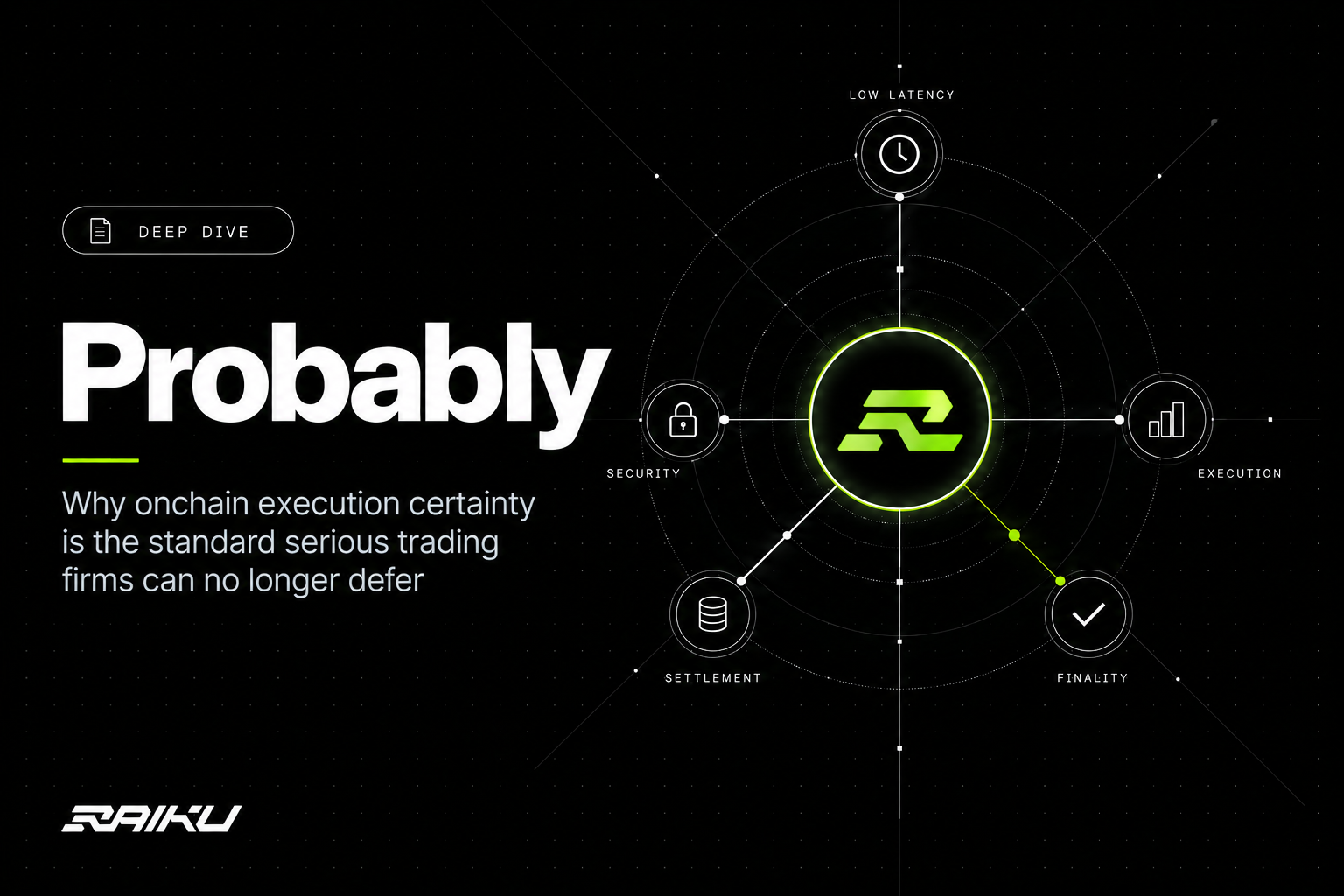
Why onchain execution certainty is the standard serious trading firms can no longer defer
There is a word that gets used far too often in onchain markets.
Not by traders themselves, traders have precision embedded in how they think. Bid-offer spreads, fill rates, latency windows. The language of markets is, by necessity, the language of exactness. But ask whether a given operation will execute as intended during a period of network stress, and that precision quietly retreats. More often than people care to acknowledge, the answer is: probably.
Probably it lands. Probably it executes at the right moment. Probably the position gets filled before the opportunity has moved on. In most professional settings, probably is an acceptable hedge. In trading, it is a liability that isn’t acceptable.
The execution problem in onchain markets
Professional trading is built on the assumption that infrastructure is dependable. The order management system works. Connectivity is stable. The exchange processes the order as expected. These are table stakes, conditions that have to be met before any meaningful evaluation of strategy, alpha, or execution quality is even possible.
Onchain markets have not, historically, been able to make the same guarantees. The competitive dynamics of block construction mean that transaction inclusion is probabilistic at its core. Validators and sequencers select and order activity based on fee levels, timing, and network conditions at the precise moment a block is produced. Well-constructed instructions can fail to land. Positions arrive late. Operations that depend on sequencing miss their window.
For participants who are broadly comfortable with some execution variance, this is manageable but for a firm running strategies where timing and precision are the product itself, it is a structural problem that no amount of fee optimization fully resolves.
The issue runs deeper than operational friction. A trading operation that is genuinely scalable, that can grow in size and sophistication over time, needs infrastructure it can depend on absolutely. Clients need confirmation, not likelihood. Risk models need reliable inputs, not carefully managed probability ranges. The word probably, when it sits inside the execution layer, places a ceiling on how seriously onchain markets can be taken as a venue for professional capital.
Why onchain execution is still probabilistic
The industry's response to this, so far, has been to work around it rather than through it. Higher fees, faster retry logic, more sophisticated MEV protection, closer monitoring of network conditions. Each of these approaches reduces the probability of failure in meaningful ways, and the engineering behind them is often impressive.
What none of them does is eliminate the uncertainty. Instead they optimise the odds and the underlying question is will this execute, exactly as intended, at the exact moment required? Which remains open until after the fact.
This has produced an implicit bargain between onchain markets and the firms that operate in them: accept that certainty is not fully achievable, and compete on who manages uncertainty most effectively. That bargain has been absorbed so thoroughly into how the industry thinks about execution that the probabilistic model now seems less like a limitation and more like a fixed feature of the landscape. Not because it necessarily has to be, but because a credible alternative has not previously existed.
What the Engineering Contract actually does
Raiku developed the Engineering Contract to solve this problem directly. The Engineering Contract is a reserved blockspace agreement: a contractual commitment that specific activity will be included in Raiku's blocks, in specific positions, before block construction begins. Rather than intervening at the point of submission and optimising for the best available outcome, it intervenes earlier, securing the execution commitment in advance, through contract, rather than competing for it in real time.
Raiku operates a Solana validator and the Engineering Contract sits within that validator, giving counterparties like trading firms, asset managers, protocols, a defined obligation rather than a probabilistic expectation. It’s an important distinction as this is not a priority queue, not a higher fee tier, not a preference. It is a contractual guarantee of onchain execution certainty.
The practical consequences extend further than they might initially appear. When execution is certain rather than probable, the design of strategies changes. Risk models can be tighter because the inputs are more reliable. Operational overhead built around managing execution uncertainty like the monitoring, the retries, the contingency planning can be meaningfully reduced. The conversation with counterparties and clients moves from a description of likely outcomes to a confirmation of agreed ones.
The Certainty Economy and what it means for trading firms
Raiku introduced the concept of the Certainty Economy to describe the direction onchain markets are heading. The Certainty Economy is the thesis that as serious capital moves onchain, execution certainty will become as fundamental a requirement as latency, liquidity, or cost, and that the firms and infrastructure providers who establish certainty as a standard, rather than a premium, will define how professional onchain markets mature.
Traditional financial markets built settlement finality, clearing certainty, and execution guarantees into their infrastructure from the beginning, because the firms operating in those markets could not function without them. Onchain markets are reaching a point where the same logic applies.
Every firm operating in onchain markets today has developed a considered approach to execution uncertainty. Those approaches are often sophisticated and the improvements they deliver are real. But sophisticated management of a probabilistic environment is still a probabilistic environment, and the ceiling that places on what onchain markets can become for institutional capital is real too.
The Engineering Contract offers a different starting point. Not how to manage the uncertainty that exists, but what becomes possible for firms and strategies once that uncertainty is no longer the foundation they are building on. Probably, for the firms that get there first, will stop being the answer they give.